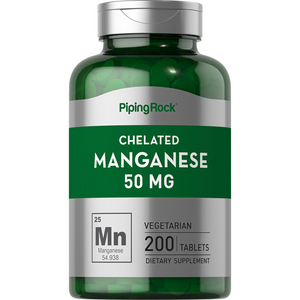
Piping Rock Manganese 50 mg in a 200 tablet bottle is a trace mineral that contributes to protecting cells from oxidative stress and to maintaining normal bone. One tablet carries the full dose with no repeat during the day, and a 200 count covers an extended period of use. Manganese is rarely sought on its own, since most people meet it inside multi-mineral blends, and this bottle offers it alone at a stated dose for anyone who wants it that way.
What is manganese?
Manganese is an essential trace mineral the body needs in small amounts, concentrated in bone, liver, kidney and pancreas. The body's cells cannot make it, so all of it comes from food or a supplement, and its richest natural sources are whole grains, nuts, legumes, tea and leafy greens. Inside the cell, manganese works as a cofactor sitting at the heart of particular enzymes and being used again and again, rather than as building material that gets consumed, which is why small amounts suffice.
Benefits of manganese
- Protection from oxidative stress: manganese contributes to protecting cell components from oxidation.
- Connective tissue formation: manganese takes part in building cartilage and connective tissue.
- Maintaining normal bone: manganese contributes to keeping bone tissue in its normal state.
- Energy metabolism: manganese contributes to normal energy-yielding metabolism.
- Carbohydrate metabolism: manganese takes part in pathways handling blood sugar in the liver.
- Amino acid metabolism: manganese sits in enzymes processing the products of protein breakdown.
How it works in the body
Manganese sits at the centre of a limited set of enzymes, the best known being mitochondrial superoxide dismutase (MnSOD), which handles the superoxide radical generated inside mitochondria during energy production, in the very place that radical arises. Manganese also sits in arginase, the enzyme closing the urea cycle in the liver, in the glycosyltransferases that build proteoglycans in cartilage, and in prolidase, which takes part in recycling proline for collagen construction. Absorption itself happens in the small intestine at a limited rate, through a transporter shared with iron, which is why the two minerals compete on the way in.
What sets this formula apart
Piping Rock places 50 mg of manganese in one tablet, a high figure for a mineral the body needs in very small quantities, which makes this product suited to a defined programme under professional supervision rather than open-ended general use. Manganese also differs fundamentally from water-soluble vitamins here: its exit route runs through the liver and bile rather than the kidneys and urine, meaning an excess is not corrected by rapid clearance the way it is with vitamin C or the B vitamins. The dry tablet form matches minerals that need no lipid carrier, and a 200 count covers a long stretch.
Who is it for?
- Anyone following a trace mineral support programme under professional supervision.
- People who want manganese on its own at a stated dose rather than inside a multi-mineral blend.
- Those whose diet is light on whole grains, nuts and legumes.
- Anyone interested in bone and connective tissue support within a broader routine.
- People who want one tablet a day with no repeat dose.
How to use
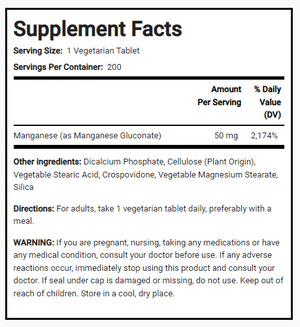
Adults: one tablet daily, preferably with a meal, or as directed by a healthcare professional. Do not exceed this dose, since manganese is a trace mineral needed in small amounts and its clearance route is slow. Separating the manganese tablet from iron, calcium and zinc supplements within the day also helps, as they crowd onto closely related absorption pathways.
Product details
- Form: tablet
- Dose: 50 mg manganese per tablet
- Count: 200 tablets
- Brand: Piping Rock, United States
FAQ
What is the difference between manganese and magnesium?
Manganese and magnesium are entirely different minerals despite how close the names sound. Magnesium is a major mineral needed in hundreds of milligrams and involved in a large number of enzymatic reactions, while manganese is a trace mineral needed in far smaller amounts and working in a limited set of enzymes such as mitochondrial superoxide dismutase.
Which foods supply manganese?
The richest dietary sources of manganese are whole grains, nuts, legumes, tea and leafy greens, mostly plant foods. Daily manganese intake therefore tends to be lower in people who rely on refined foods and eat little of this kind of source.
Why does surplus manganese leave through bile?
The body clears excess manganese by secreting it into bile produced by the liver, after which it leaves with waste, rather than excreting it in urine as it does with water-soluble vitamins. That route is slower, which is why not exceeding the stated dose on this Piping Rock tablet and consulting a doctor with any liver condition both matter.
Cautions
- Not intended for pregnant or breastfeeding women.
- Not intended for anyone under 18.
- Consult a doctor when taking long-term medication or with a liver condition, since manganese clearance runs through the liver and bile.
- Do not exceed the stated dose and do not use long term without professional supervision.
- Not a substitute for a balanced diet.
Are your products genuine?
Yes. Everything is imported from the United States, the United Kingdom and Turkey, and the Best Before date is printed on each product page.
How long does delivery take?
One to two working days, to every governorate in Jordan.
What does delivery cost?
Free on orders over 29 JOD. Below that, a small delivery fee applies, which our team confirms with you when the order is placed.
How can I pay?
Cash on delivery, Visa or Mastercard at the door, or CliQ. PayPal is available on request — message us and we will send you a payment link.
Can I return a product?
Yes. Our policy is deliberately flexible: if the product is not right for you, for any reason, you get a full refund including the delivery fee. Details in our Refund Policy.
How do I reach you?
WhatsApp +962 7 8162 0564, email qtrat.al97ah@qtrat.net, or through Facebook and Instagram.